Creating a cohesive landscape screen requires more than simply digging holes and dropping root balls into the earth. Homeowners often select Arborvitae for their fast growth and dense, year round foliage, yet these evergreens frequently succumb to the dreaded needle browning that ruins a property’s curb appeal. As a landscape architect, I have observed that the root cause of this decline is rarely the climate or a lack of sunlight. Instead, the failure typically begins underground. The best soil for Arborvitae must provide a precise balance of drainage, aeration, and nutrient availability to prevent the physiological stress that leads to desiccation and fungal pathogens.
When a privacy screen begins to turn rust orange or brittle brown, it signals a breakdown in the plant’s ability to transport water from the roots to the furthest reaching needles. In many suburban developments, soil is heavily compacted by construction machinery, leaving a dense layer of clay that acts like a ceramic bowl. This creates a bathtub effect where water sits around the roots, depriving them of oxygen and causing root rot. Conversely, excessively sandy soil might drain so rapidly that the Arborvitae cannot absorb enough moisture to sustain its vertical growth. Achieving the perfect environment involves transforming the existing site conditions into a rich, loamy soil blend that mimics the natural forest floor.
Landscape Design Principles
Integrating Arborvitae into a professional landscape plan requires an understanding of spatial hierarchy and visual balance. These trees serve as the vertical anchor of the garden, providing a consistent “green wall” that frames other ornamental features. Symmetry is vital when using Emerald Green Arborvitae for formal entries or property borders. If one tree in a row of ten begins to brown due to poor soil, the entire visual rhythm is broken, creating a glaring gap in the design. We often use these trees to establish focal points at the end of a long flagstone walkway or to soften the hard angles of a concrete retaining wall.
Elevation layering is another critical principle. We rarely plant Arborvitae as a standalone element; instead, we transition the height from the tall tree line down to medium sized shrubs and eventually to groundcovers. This creates a tiered effect that adds depth to the backyard. Irrigation planning must be integrated into the design phase to ensure that every tree receives uniform hydration. In a professional layout, we prioritize the “right plant, right place” philosophy, ensuring that the Arborvitae are not placed in low lying areas where runoff accumulates. Proper grading is the silent partner of landscape design, as a subtle 1 percent to 2 percent slope away from the root zone can be the difference between a thriving hedge and a dying one.
Plant and Material Selection
| Plant Type | Sun Exposure | Soil Needs | Water Demand | Growth Speed | Maintenance Level |
| :— | :— | :— | :— | :— | :— |
| Emerald Green | Full Sun / Part Shade | Loamy, Well-Drained | Moderate | Slow to Medium | Low |
| Green Giant | Full Sun | Fertile, Acidic to Neutral | Moderate to High | Fast | Medium |
| American Pillar | Full Sun | Moist, Organic Loam | High | Very Fast | Moderate |
| Nigra Arborvitae | Full Sun / Part Shade | Heavy Clay Tolerant | Moderate | Medium | Low |
| Techny | Full Sun / Part Shade | Humus-Rich Loam | Moderate | Medium | Low |
Implementation Strategy
The process of installing a high performance hedge begins with site preparation. You must test the existing soil pH, aiming for a range between 6.0 and 8.0. Most Arborvitae species prefer a slightly acidic to neutral environment. Start by marking the planting line with surveyor’s string to ensure absolute straightness. Use a mechanical auger or a sharp spade to dig a trench that is twice as wide as the root ball but no deeper than its height. This width is crucial because the best soil for Arborvitae must be loose enough for new roots to expand laterally without resistance.
For the backfill mix, combine the native soil with sphagnum peat moss, composted cow manure, and a portion of coarse builder’s sand. This mixture creates the ideal sandy loam texture. If you are dealing with heavy clay, incorporate gypsum to help break up the soil aggregates. As you fill the trench, tamping the soil down lightly with your foot will remove large air pockets without causing the compaction that leads to needle browning. A critical step in the implementation is the application of a 3-inch layer of shredded hardwood mulch. This mulch should be kept away from the direct contact of the trunk to prevent bark rot, yet it must cover the entire root drip line to retain moisture during the heat of summer.
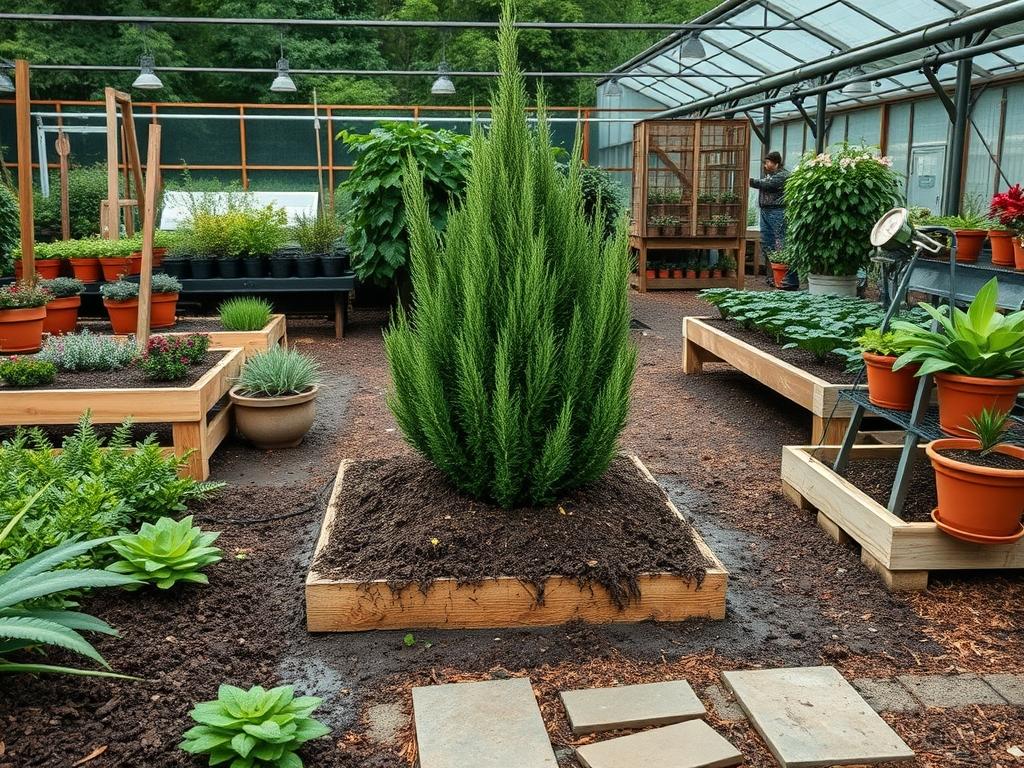
Grading and drainage are equally important. If the site is prone to standing water, consider planting the trees on a slightly raised berm of soil, approximately 6 to 12 inches above the surrounding grade. This ensures that the base of the root system remains above the saturation zone during heavy rains. Finally, install a soaker hose or a drip irrigation system along the base of the hedge. Overhead watering should be avoided, as wet needles in a dense canopy can encourage fungal growth, which is another common cause of browning.
Common Landscaping Failures
The most frequent mistake in Arborvitae management is root overcrowding. Many homeowners, in an attempt to achieve instant privacy, plant the trees too close together. This creates intense competition for nutrients and water, eventually leading to “die-back” on the interior branches where air circulation is restricted. For Green Giant Arborvitae, a spacing of at least 5 to 6 feet on center is necessary, while Emerald Green varieties can be spaced 2 to 3 feet apart.
Another failure involves improper drainage. When a tree is planted too deep, the “flare” of the trunk is buried. This leads to stem girdling and prevents the tree from effectively moving sugars from the needles to the roots. Soil compaction from heavy foot traffic or lawn equipment also inhibits oxygen exchange, effectively suffocating the tree. It is also common to see a failure in irrigation consistency; Arborvitae do not have deep taproots, so even a short period of drought in the autumn can cause the needles to brown and drop during the winter as the tree loses moisture to cold winds.
Seasonal Maintenance
Managing a professional landscape requires a calendar based approach. In the spring, perform a soil test to check for nutrient depletion. Apply a slow release nitrogen-rich fertilizer just as the new growth begins to emerge. This is also the time to inspect for bagworms or spider mites, which can cause browning that mimics soil issues. Use a high-pressure hose to knock off any debris or winter salt that may have accumulated on the foliage.
During the summer, the focus shifts to hydration. A deep soak twice a week is superior to shallow daily watering. If the needles feel brittle, it is a sign that the evapotranspiration rate is exceeding the water uptake. In the autumn, keep watering the trees until the ground freezes. Many people stop watering in October, but Arborvitae are evergreens that continue to transpire water throughout the winter. Finally, in winter, protect young trees in colder climates by wrapping them in burlap or using an anti-desiccant spray to minimize moisture loss from the wind. This consistent care ensures the soil and tree work in harmony to maintain a vibrant green screen.
Professional Landscaping FAQ
What is the best soil for Arborvitae for fast growth?
The fastest growth occurs in a sandy loam enriched with organic compost. This provides the necessary drainage while ensuring the roots have constant access to nutrients. High organic matter content helps the soil retain moisture without becoming waterlogged or compacted.
How do I fix brown needles on my mature trees?
First, check the soil moisture levels. If the soil is dry, increase deep watering sessions. If the soil is soggy, improve drainage by adding French drains. Trim away the dead, brittle branches and apply a balanced 10-10-10 fertilizer in spring.
Can I grow Arborvitae in heavy clay soil?
While not ideal, you can succeed by amending the clay with organic matter and gypsum. Planting the trees in raised berms is essential in clay areas to prevent root rot, as it allows gravity to pull excess water away.
Why are my trees browning only on the inside?
Interior browning is often a natural shedding process or a sign of poor air circulation. Ensure proper spacing during installation and use pruning shears to thin out some of the outer growth, allowing light and air to reach the inner branches.
How much mulch do my Arborvitae trees need?
Apply a layer of 3 inches of wood mulch over the root zone. Ensure the mulch does not touch the trunk, as this can trap moisture against the bark and invite pests. Mulch regulates soil temperature and prevents moisture evaporation.