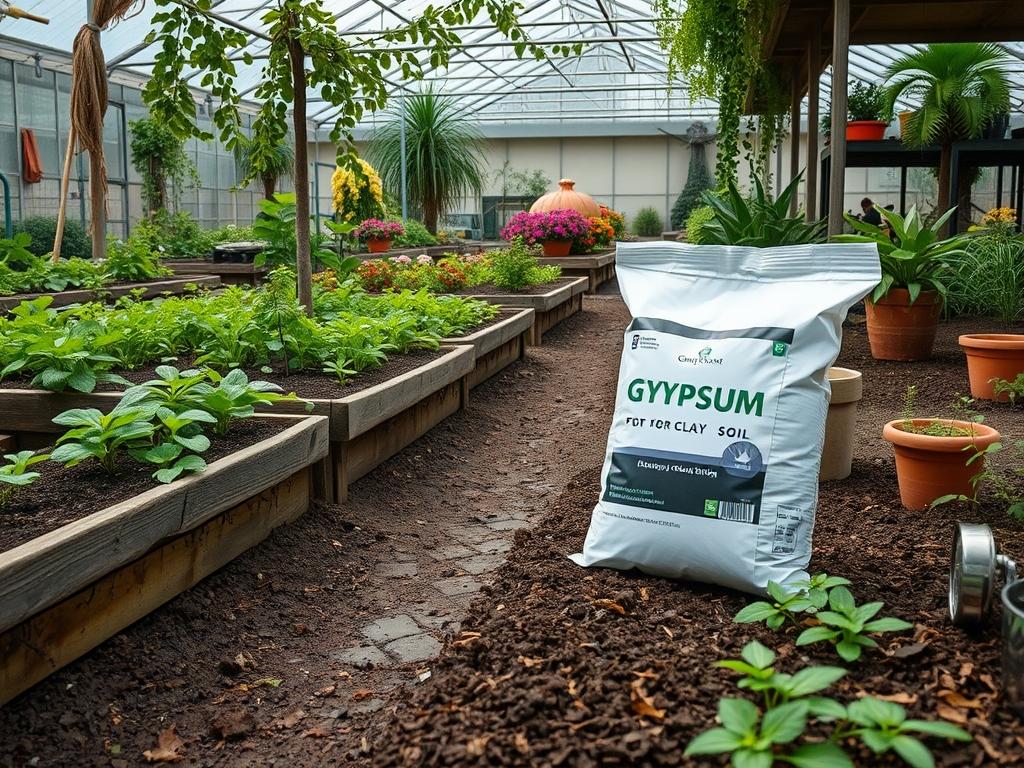
Commercial landscapes and residential estates often struggle with the structural limitations of heavy clay. This dense, fine-textured soil acts as a barrier to both oxygen and water, creating a hostile environment for expensive specimens and lush turf. In professional landscaping, we view the soil as the engineering foundation of every project. If the foundation is unstable or impermeable, the aesthetic value of the design will inevitably crumble. Utilizing Gypsum for clay soil is one of the most effective ways to address these systemic issues. It provides a chemical solution to a physical problem by promoting a process called flocculation. This process causes tiny clay particles to aggregate into larger crumbs, creating the essential pore space needed for a thriving root system. Without this intervention, clay remains compacted and anaerobic, leading to root rot and stunted growth that can diminish curb appeal and significantly lower property value.
The challenge of clay is particularly acute in regions with high rainfall or extreme seasonal shifts. When wet, clay expands and loses its structural integrity; when dry, it shrinks and cracks like concrete. For a landscape architect, these fluctuations make it difficult to maintain stable grading and prevent erosion. By integrating Gypsum, or calcium sulfate dihydrate, into the soil management plan, we can stabilize the soil structure without drastically altering the pH levels. This is a critical distinction, as many traditional soil amendments like lime will raise the alkalinity, potentially harming acid-loving plants such as Azaleas or Blueberries. Gypsum works by replacing sodium ions with calcium ions. This chemical exchange reduces the “stickiness” of the clay, allowing water to percolate through the profile rather than pooling on the surface.
Landscape Design Principles
Successful landscape design necessitates a harmony between form and function. When working with compactible soils, symmetry is often the first casualty. If one side of a symmetrical entryway has poor drainage while the other is manageable, the resulting uneven plant growth destroys the visual balance. We use Gypsum for clay soil to ensure uniform moisture distribution across the entire site. This allows for the precise execution of focal points, such as a Japanese Maple or a custom Stone Fountain, without the risk of the surrounding ground becoming a muddy basin.
Elevation layers are another core principle where soil health is paramount. In a tiered landscape design, retaining walls and terraces are used to manage slope and create visual interest. However, the weight of the soil behind a Retaining Wall creates immense lateral pressure, which is exacerbated if the clay is saturated and heavy. By improving the internal drainage of the clay with Gypsum, we reduce the hydrostatic pressure on these structures, extending their lifespan. Furthermore, well-structured soil supports cleaner lines for walkways and hardscaping. When the subsoil is prone to shifting due to compaction and expansion, pavers and flagstones are more likely to heave and crack. A stable soil base ensures that the outdoor living space remains safe and attractive for years to come.
Plant and Material Selection
The following table outlines plants that are often used in clay-heavy landscapes, provided the soil structure has been improved with proper amendments.
| Plant Type | Sun Exposure | Soil Needs | Water Demand | Growth Speed | Maintenance Level |
| :— | :— | :— | :— | :— | :— |
| Red Maple | Full Sun | Moist, Amended Clay | Medium-High | Fast | Low |
| Coneflower | Full Sun | Well-Drained Clay | Low | Moderate | Low |
| Hostas | Shade | Rich, Loose Clay | Medium | Moderate | Low |
| Daylilies | Part Sun | Versatile/Amended | Medium | Fast | Very Low |
| Switchgrass | Full Sun | Deep, Heavy Soil | Low | Fast | Low |
| Boxwood | Part Sun | Well-Drained Loam | Medium | Slow | Medium |
Selecting the right materials extends beyond plants. In clay environments, we use Coarse Sand, Pea Gravel, and Hardwood Mulch to assist in managing surface moisture. However, these materials are only effective if the underlying clay has been treated to allow for downward water movement.
Implementation Strategy
Correctly preparing a backyard or garden layout requires a systematic approach to soil management. The first step involves site grading. We recommend a slope of at least 2 percent away from any permanent structures to prevent foundation damage. Once the basic topography is established, the application of Gypsum for clay soil should begin. For heavy compaction, a rate of 40 pounds per 1,000 square feet is a standard professional starting point. This material should be spread using a Broadcast Spreader to ensure even coverage across the entire planting zone.
The next phase is mechanical integration. Using a Rear-Tine Tiller, work the gypsum and organic compost into the top 8 to 12 inches of the soil. This depth is critical because it encompasses the primary root zone for most ornamental shrubs and perennials. After tilling, the area should be raked smooth and allowed to settle. We then install edging, such as Steel Header or Natural Stone, to define the garden beds. For the final layer, a 3-inch to 4-inch depth of Organic Mulch is applied. This mulch acts as an insulator, keeping the soil cool and reducing the rate at which the clay dries out and hardens. If the area is designated for turf, a Core Aerator should be used annually to continue the process of breaking down compaction.
Common Landscaping Failures
The most frequent mistake in clay landscaping is the failure to address drainage at the source. Many homeowners attempt to “fix” clay by simply adding a thin layer of topsoil over the heavy base. This creates a perched water table where the water moves through the loose top layer but stops once it hits the hard clay, effectively drowning the plant roots. This error, often called the “bathtub effect,” can kill a Specimen Tree within a single season.
Another common failure is improper plant spacing. In clay soil, roots tend to grow wider and shallower because oxygen is scarce in the deeper layers. If plants are crowded, they compete fiercely for the limited pore space, leading to stunted growth and increased disease susceptibility. Irrigation inefficiency is also a major hurdle. Clay has a low infiltration rate, meaning water must be applied slowly. If an Irrigation System delivers water faster than the clay can absorb it, the result is runoff and wasted resources. Professionals avoid this by using Drip Irrigation or high-efficiency nozzles that deliver water in short, frequent bursts, matching the soil’s absorption capacity after Gypsum treatment.
Seasonal Maintenance
Landscape management is a year-round commitment. In the Spring, the focus is on remediating the compaction caused by winter snow and heavy rains. This is the ideal time for a secondary application of Gypsum for clay soil to help the ground “wake up” and begin breathing again. We also recommend checking the mulch depth and refreshing it to suppress early weed growth.
Summer maintenance centers on moisture management. Because clay can become hydrophobic when it dries completely, it is important to monitor soil moisture with a Soil Probe. If the ground is too hard to penetrate with the probe, the clay is too dry. In Autumn, the removal of fallen leaves is essential; if left to mat down, they can create an air-tight seal that suffocates the soil. This is also the best time for planting new trees, as the cooler temperatures allow roots to establish in the amended soil without the stress of summer heat. During Winter, minimize traffic on the landscape. Walking on wet clay causes severe compaction that can undo a full year of soil improvement efforts.
Professional Landscaping FAQ
How long does it take for gypsum to show results?
While chemical changes begin immediately, physical improvements in soil structure usually take 6 to 12 months. Visible increases in drainage and root penetration typically become apparent after a full seasonal cycle of rain and temperature shifts.
Is gypsum a substitute for organic matter?
No, gypsum and organic matter serve different purposes. Gypsum chemically breaks down clay bonds, while Compost or Leaf Mold provides nutrients and biological activity. For best results, professional landscapers use both materials in tandem during site preparation.
Can I use gypsum on my existing lawn?
Yes, you can apply gypsum to established turf using a Spreader. It is most effective when applied immediately after Core Aeration, as this allows the mineral to reach deeper into the soil profile where compaction is most severe.
Will gypsum change the acidity of my garden?
Unlike lime, gypsum is pH neutral. It will not make your soil more alkaline or acidic. This makes it a safe choice for nearly all landscape designs, regardless of whether you are growing Rhododendrons or alkaline-tolerant Grasses.
How often should I apply gypsum to clay?
For residential gardens, an annual application is usually sufficient to maintain soil porosity. In areas with extreme compaction or high sodium levels, a bi-annual application in both Spring and Autumn may be necessary to sustain the desired soil structure.