Successful landscape architecture relies as much on what remains hidden beneath the surface as it does on the visual arrangement of plant life. When designing for arid or semi-arid environments, the primary challenge involves managing the relationship between moisture retention and gas exchange within the root zone. High-end curb appeal is often a matter of structural health; a garden that looks lush in its first month but begins to yellow or rot by its six-month anniversary represents a failure in foundational planning. For developers and homeowners alike, the transition to water-wise landscaping is more than a trend. It is a strategic move toward sustainability and reduced overhead. The secret to this longevity is understanding that the best soil for succulents is essentially a drainage system disguised as a growing medium.
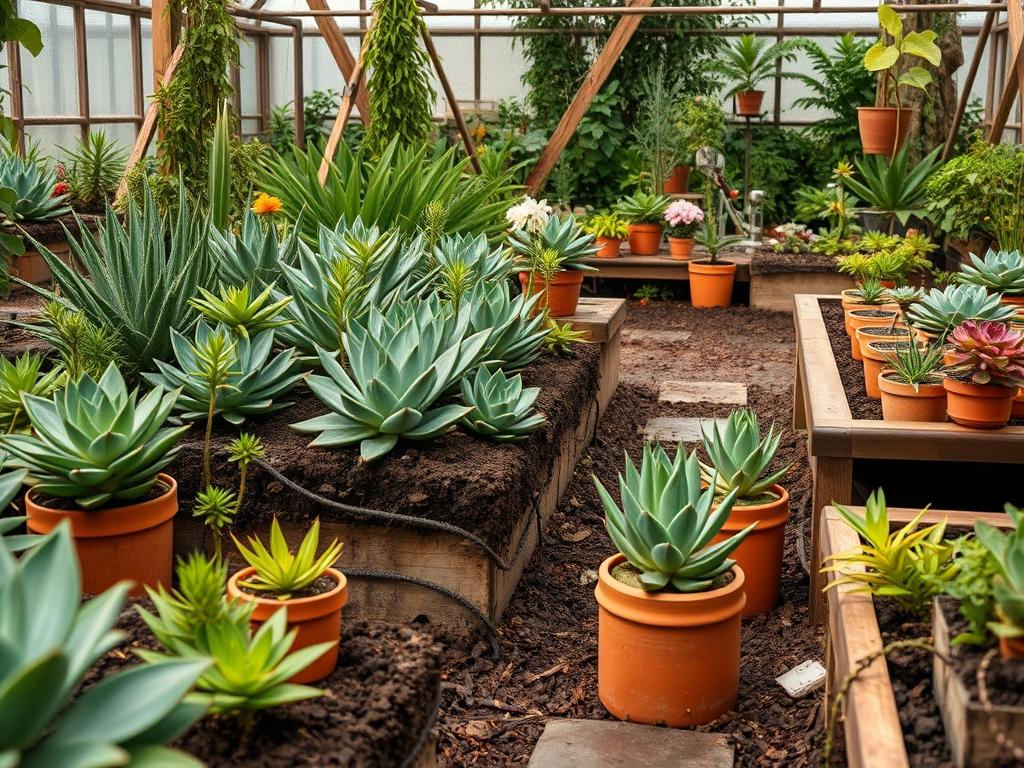
In large-scale outdoor projects, we prioritize functionality. This means the soil must support the massive weight of a mature Agave or a heavy Saguaro Cactus while preventing the structural instability caused by soil subsidence or compaction. When we plan these environments, we look at the site’s topography to ensure that water never pools around the crown of the plants. Elevation changes, introduced through tiered garden beds or Retaining Walls, provide a natural avenue for runoff. By focusing on the physical properties of the substrate, we create a resilient landscape that maintains its architectural integrity through harsh seasons, ensuring that the visual impact remains sharp and intentional rather than overgrown or neglected.
Landscape Design Principles
Effective succulent landscaping begins with the principle of visual balance and focal points. We often use a “thriller, filler, and spiller” approach but on a grander, more permanent scale. A large-scale Agave Weberi might serve as the primary focal point, anchored by its architectural symmetry and substantial mass. Around this center, we layer different heights of plants to create depth. Elevation layers are critical; they break the monotony of the ground plane and allow for secondary drainage points. By utilizing a Laser Level to plan 1 to 2 percent slopes, we can direct rainfall away from sensitive roots and toward hidden French Drains or bioswales.
Symmetry does not always mean a mirror image; it can be achieved through the distribution of physical weight. For instance, a heavy Golden Barrel Cactus on one side of a walkway can be balanced by a cluster of smaller, more delicate Echeveria planted among large River Rocks. Walkways should be designed to invite movement through the space, using materials like Decomposed Granite or Flagstone that allow for some permeation. Irrigation is another pillar of design. While succulents are drought-tolerant, they are not drought-proof. We plan Drip Irrigation systems that deliver water directly to the root zone, avoiding the foliage where standing water can lead to fungal infections. This precise delivery, combined with the best soil for succulents, creates an environment where plants thrive with minimal human intervention.
Plant and Material Selection
| Plant Type | Sun Exposure | Soil Needs | Water Demand | Growth Speed | Maintenance Level |
| :— | :— | :— | :— | :— | :— |
| Agave Americana | Full Sun | Gritty, Mineral | Very Low | Moderate | Low |
| Echeveria | Partial Sun | High Porosity | Low | Fast | Medium |
| Sedum Stonecrop | Full to Part Sun | Gritty Loam | Moderate | Fast | Low |
| Golden Barrel Cactus | Full Sun | 70% Inorganic | Very Low | Slow | Low |
| Aloe Striata | Partial Sun | Well-Draining Loam | Low | Moderate | Low |
| Blue Chalksticks | Full Sun | Sandy, Porous | Low | Fast | Low |
| Jade Plant | Partial Sun | Standard Gritty Mix | Low | Moderate | Medium |
Implementation Strategy
The construction of a succulent-focused landscape begins with site grading. You must ensure the base layer consists of native soil that has been properly scarified to prevent a “potting effect,” where water becomes trapped in a hole of soft soil surrounded by hard clay. After grading, we install the Hardscaping elements, such as Curbing or stones, to define the beds. For the planting medium itself, the best soil for succulents is a custom blend. We typically recommend a ratio of 50 percent Pumice or Perlite, 25 percent Coarse Sand, and 25 percent high-quality organic matter like Coconut Coir. This ensures that the soil has enough Macropores for oxygen to reach the roots but enough Micropores to hold a small amount of essential moisture for hot days.
During the installation phase, we apply a Geotextile Fabric only in specific areas to prevent the migration of fine particles into the drainage layers. When placing the plants, the root ball should be set slightly higher than the surrounding soil line. This is a professional trick to prevent crown rot; the water will naturally move away from the sensitive base of the plant. Finally, we apply a 2 inch layer of inorganic Mulch, such as Crushed Lava Rock or Pea Gravel. This mulch serves three purposes: it suppresses weeds, regulates soil temperature, and provides a clean, professional finish that enhances the color of the succulents.
Common Landscaping Failures
The most frequent mistake in succulent gardening is the over-reliance on standard garden soil or heavy peat-based potting mixes. While these products work for traditional perennials, they act like a sponge in a succulent bed, holding water for days and suffocating the root system. Soil compaction is another silent killer. When heavy machinery or frequent foot traffic compresses the soil, the Bulk Density increases and the air spaces vanish. Without oxygen, roots die, and the plant eventually collapses.
Improper spacing is also a major concern. It is tempting to plant succulents close together for an immediate full look, but many species like Aloe Thraskii or Agave Ovatifolia grow considerably over a five-year period. Overcrowding leads to poor air circulation, which invites pests like Mealybugs and Scale. Furthermore, many homeowners fail to account for the hydro-phobic nature of dry peat moss. If the soil becomes too dry, it can actually repel water, causing it to run off the surface without ever reaching the roots. Testing the soil per-meability with a Soil Moisture Meter or a simple percolation test can prevent these common catastrophes.
Seasonal Maintenance
Landscape management is a year-round commitment. In the spring, the focus is on growth and nutrition. As temperatures rise, we recommend a low-nitrogen, high-potassium Liquid Fertilizer diluted to half strength. This is also the best time to inspect the Drip Emitters for clogs and to perform any necessary pruning of dead lower leaves on Agaves or Aloes. During the summer, the main task is monitoring for heat stress. While these plants love the sun, extreme heat waves may require the temporary use of Shade Cloth for more delicate species like Echeveria.
As autumn approaches, we scale back irrigation significantly. This allows the plants to enter a period of hardening off, which strengthens their tissues for cooler temperatures. You should clear any fallen leaves or organic debris from the surface of the gravel Mulch, as rotting organic matter can trap moisture and cause rot against the plant stems. In winter, protection from frost is paramount. For sensitive species, a layer of Frost Cloth can be draped over the plants during cold snaps. Avoid watering entirely if the ground is frozen. A well-constructed succulent garden, built on the foundation of the best soil for succulents, should remain largely dormant and stable during these colder months, ready to burst into growth once the spring sun returns.
Professional Landscaping FAQ
What are the essential components of the best soil for succulents?
The most effective mix consists of inorganic materials like Pumice, Perlite, or Expanded Shale combined with Coarse Sand. A small organic fraction, such as Coconut Coir or Pine Bark, provides necessary nutrients without retaining excessive, stagnant moisture around the roots.
Can I use regular potting soil if I add sand?
Standard potting soil often contains too much Peat Moss, which becomes either waterlogged or hydrophobic. To adapt it, you must mix it with at least 50 percent Gritty Amendments like Fine Gravel or Turface to ensure the drainage is sufficient for succulents.
How deep should the succulent soil bed be?
For most small to medium succulents, a soil depth of 8 to 12 inches is sufficient. However, for larger specimens like Columnar Cacti or large Agaves, a depth of 18 to 24 inches is required to provide both nutrients and stability.
Why is my succulent soil surface turning white?
This is often caused by Mineral Salts accumulating from tap water or fertilizer. Use a Leaching Process by flushing the soil with distilled water or rainwater. Improving the soil’s porosity and using high-quality Inorganic Mulch can help minimize this surface crusting.
Is it necessary to use a landscape fabric under succulent beds?
Usually, it is better to avoid it directly under the soil mix. Fabric can trap moisture and prevent healthy root expansion. Instead, use it only under heavy Hardscape elements to prevent stones from sinking into the sub-grade while allowing the plants to breathe.